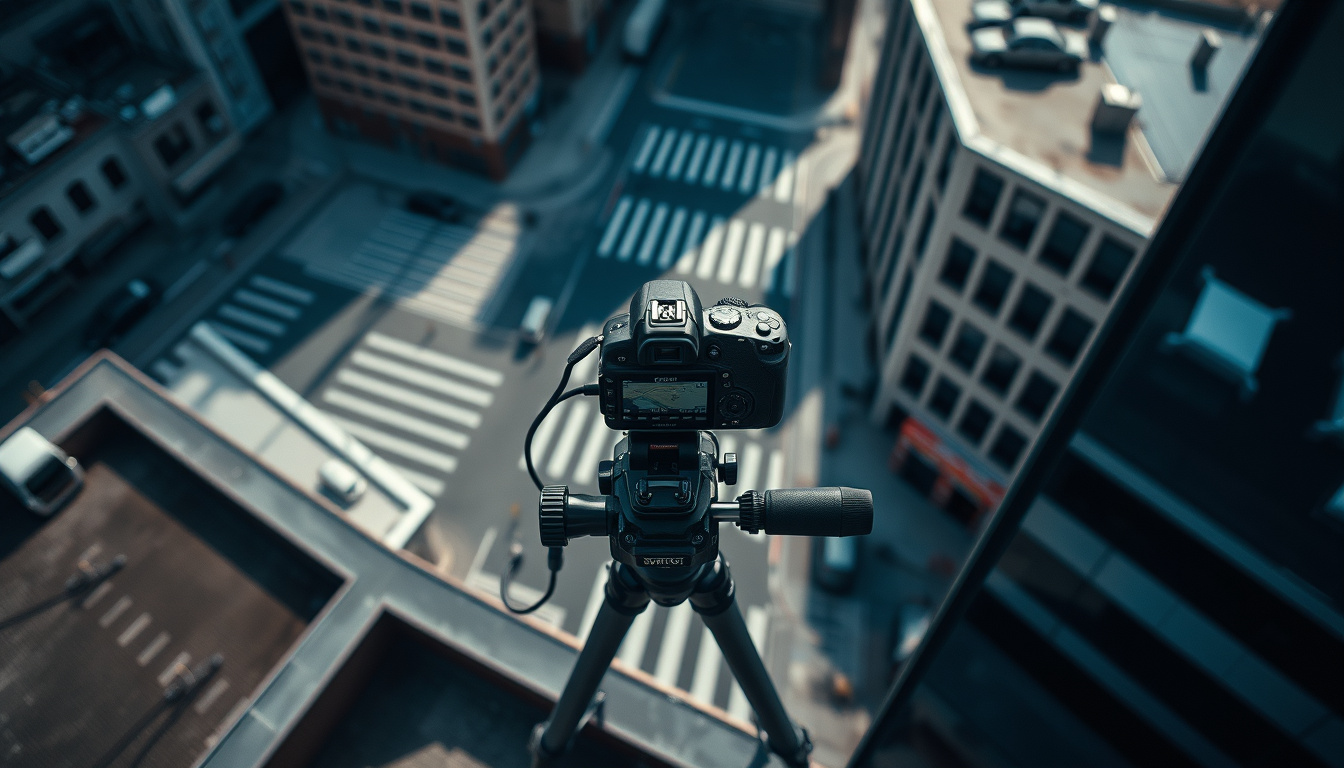
You’ve seen it a hundred times: a character stands alone in a vast room, and the camera peers down from above—that shift in perspective does more than frame the scene, it tells you exactly how to feel. We’ll walk through the definition, the gear, and the storytelling purpose behind this classic camera angle, drawing on practical advice from Backstage (industry trade publication), Soundstripe (music and production resource), and StudioBinder (film production software).
Also known as: Bird’s-eye view (extreme high angle) ·
Primary effect: Subject appears small, vulnerable, or insignificant ·
Common film genres: Drama, thriller, horror
Quick snapshot
- Camera looks down at subject from above (Backstage)
- Creates a sense of vulnerability or powerlessness (Soundstripe)
- Often used to establish a scene (StudioBinder)
- Use ladder, tripod, drone, or crane (Backstage)
- Consider emotional intent when choosing angle severity (Backstage)
- Light subjects based on camera’s view to avoid flatness (Soundstripe)
- Adds narrative information to the scene (StudioBinder)
- Creates an emotional response, such as vulnerability (StudioBinder)
- Makes characters seem diminished or powerless (Soundstripe)
- Subject appears smaller and less powerful (Soundstripe)
- Creates a sense of unease or tension (StudioBinder)
- Can be used across close-up, medium, and wide framing (Backstage)
Four key definitions, one pattern: high-angle shots always place the camera above the subject, but the emotional impact shifts with context and severity.
| Label | Value |
|---|---|
| Also known as | Bird’s-eye view (extreme high angle) (Backstage) |
| Primary effect | Subject appears vulnerable or insignificant (Soundstripe) |
| Equipment | Ladder, drone, crane, boom arm (Backstage) |
| Common in genres | Horror, drama, thriller (StudioBinder) |
What are high angle shots?
Definition and key characteristics
- A high-angle shot is taken from above the subject, with the camera pointing downward (Backstage).
- It can make the subject appear small, vulnerable, or insignificant (Soundstripe).
- StudioBinder notes that high-angle shots are often used to establish a scene or show a character’s helplessness.
A filmmaker who wants the audience to feel the weight of a character’s isolation has a direct tool: raise the camera. The higher it goes, the more the subject shrinks in the frame.
Common uses in film
- Directors use high-angle shots to add narrative information that would be hard to see from another angle (StudioBinder).
- They create tension, especially at extreme elevations (StudioBinder).
- Soundstripe emphasizes that the technique makes characters seem less powerful, which is why it dominates horror and thriller genres.
The implication: the same angle that conveys vulnerability in a drama can signal dread in a horror film. Context is everything.
What is high angle shooting?
Distinction between high angle shot and high angle shooting
- “High angle shooting” refers to the act of physically positioning the camera above the subject (Backstage).
- It is distinct from the final “shot” itself — the process of setting up, framing, and capturing from an elevated perspective (Soundstripe).
Equipment and positioning
- Backstage recommends getting the camera physically higher using a tripod, apple box, or another safe lift.
- Soundstripe advises using tripods, cranes, or drones to elevate the camera.
- The angle can vary from slight to extreme (bird’s-eye view) (StudioBinder).
A shaky ladder or an underpowered drone can ruin a shoot before it starts. The gear decision is a safety and creative choice rolled into one.
The pattern: the more extreme the angle, the more the camera operator must prioritize stability and coordination with the crew.
What is another name for a high-angle shot?
Alternate terms: bird’s-eye view, overhead shot, top angle
- An extreme high angle is often called a bird’s-eye view (Backstage).
- An overhead shot places the camera directly above the subject (Soundstripe).
- In cinematography, “high angle” remains the standard term (StudioBinder).
Contextual usage
- “Bird’s-eye view” is more common in photography and drone work; “overhead shot” is often used in action sequences (Soundstripe).
- StudioBinder notes that the choice of term can signal the intended emotional impact — “high angle” feels technical, “bird’s-eye” feels poetic.
The trade-off: using the wrong term in a pitch or script can confuse collaborators. Stick with “high angle” for precision.
What are the 4 types of shots?
Eye-level shot, low angle shot, high angle shot, Dutch angle
- High angle is one of the four fundamental camera angles (Backstage).
- Each angle creates a different psychological effect: eye-level feels neutral, low angle makes the subject powerful, high angle diminishes it, and Dutch angle creates unease (StudioBinder).
- Soundstripe calls high angle the “polar opposite” of low angle.
The pattern: mastering these four angles gives a filmmaker a simple but powerful emotional vocabulary. High-angle shots often carry the heaviest narrative weight.
How to shoot a high angle shot?
- Step 1: Choose the right equipment
- Backstage recommends a tripod, apple box, or safe lift. Soundstripe suggests cranes or drones.
- For extreme angles, a jib arm or drone gives the most flexibility (Soundstripe).
- Step 2: Determine the desired emotional effect
- Backstage advises coordinating with the director and cinematographer on how vulnerable the character should feel.
- StudioBinder says the shot should be planned on a shot list so the DP can prepare.
The catchHigh-angle shots require extra precautions because the camera may be placed well above cast and crew — a fall or tip-over can cause injury or equipment loss (Soundstripe).
- Step 3: Position the camera and frame the shot
- After gaining height, point the camera downward (Backstage).
- Test the same setup as close, medium, and wide shots to see which framing best serves the story (Backstage).
- Soundstripe recommends adding movement when possible to make the shot more dynamic.
- Step 4: Adjust lighting and composition
- Soundstripe advises lighting subjects based on the camera’s view — shadows cast downward can flatten the image if not managed.
- Backstage says creative staging, such as asking actors to sit or lie down, helps when shooting handheld or with a Steadicam.
What this means: a high-angle shoot isn’t just about elevation. Every choice — from gear to lighting to movement — feeds the emotional message.
What’s clear and what’s still debated
Confirmed facts
- A high-angle shot is defined as the camera looking down on the subject (Backstage).
- Used to convey powerlessness or vulnerability in characters (Soundstripe).
- Can be achieved with ladders, tripods, cranes, or drones (Backstage).
What’s unclear
- Whether a high-angle shot always implies vulnerability — the effect depends on context, framing, and narrative (StudioBinder).
- The terminology (high angle vs overhead vs bird’s-eye) is not universally consistent across filmmaking communities.
- The emotional effect may vary with shot size (close-up vs wide) and the character’s position in the frame.
These certainties and uncertainties guide filmmakers in applying high-angle shots effectively.
Expert perspectives on high angle shots
In film, a high-angle shot is usually when the camera is located above the eyeline and the point of focus often gets ‘swallowed up’.
At its simplest, a high-angle shot is a filming technique where the camera looks down at the subject from above.
StudioBinder adds that a high-angle shot can be used to add narrative information, create an emotional response, or make characters seem vulnerable or diminished. (StudioBinder, film production software)
These expert views underscore the technique’s versatility.
Summary
The high-angle shot is a deceptively simple technique that packs a heavy emotional punch. For independent filmmakers and student directors working with limited gear, the trade-off is clear: a ladder and a steady hand can deliver the same narrative power as a Hollywood crane — provided you plan the shot list, coordinate with your crew, and light for the downward view. For the audience, the consequence is a moment of pure perspective: they see what the character cannot, and that gap creates the story.
youtube.com, en.wikipedia.org, polarpro.com, sparksarts.co.uk
Frequently asked questions
What equipment do I need for a high angle shot?
A ladder, tripod, apple box, drone, or crane can all work. The key is safety and stability (Backstage).
Can a high angle shot be used in photography?
Yes. The same principles apply — photographing from above can make subjects appear smaller or more abstract (Soundstripe).
What is the difference between a high angle and a low angle shot?
A high angle looks down on the subject; a low angle looks up. High angles diminish the subject; low angles empower it (Soundstripe).
How do high angle shots affect the audience?
They create a sense of vulnerability, tension, or dramatic irony by showing the character’s surroundings from above (StudioBinder).
What are famous examples of high angle shots in movies?
The opening of The Shining and the attack scene in The Birds use high-angle shots to build unease. (These are widely cited examples in film education.)
Is a high angle shot the same as a bird’s-eye view?
Not exactly. Bird’s-eye view is an extreme high angle taken directly above the subject (Backstage).
What is the psychological effect of a high angle shot?
The subject appears smaller, weaker, and less in control, which can evoke pity, fear, or suspense (Soundstripe).
How do you prevent a high angle shot from feeling too distant?
Use close-up framing or add movement to maintain emotional connection with the subject (Soundstripe).
These answers clarify common questions about high-angle shot technique.
Related reading
- F1 Film: Cast, True Story, Brad Pitt Driving, Tom Cruise — racing cinematography uses high-angle drone shots extensively.
- Better Call Saul: As Good as Breaking Bad? Watch Order & Guide — the series is known for deliberate, cinematic camera angles including high-angle setups.
Explore these related articles for more cinematic insights.

Ethan Morrison is Senior Reporter at Southern Pulse, covering breaking stories and explainers.