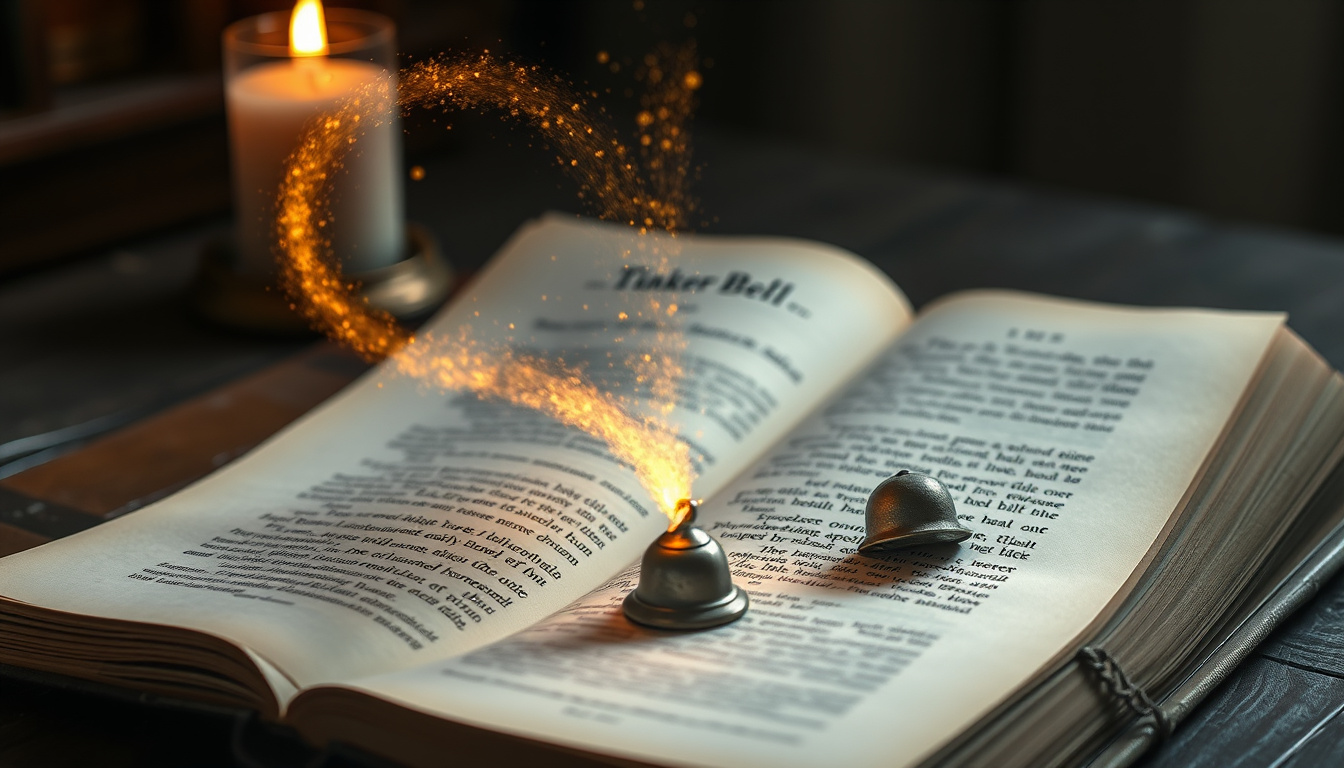
Few fairies have sparked as much curiosity as the tiny figure who flits across the stage of Neverland. Tinker Bell began as a silent, temperamental patch of light in an Edwardian theatre and became one of Disney’s most recognizable mascots.
First appearance: 1904 in J. M. Barrie’s play Peter Pan · Creator: J. M. Barrie · Disney debut: 1953 animated film Peter Pan · Disney franchise entry count: 6 feature films (2005–2014) · Personality archetype: Tinker / trickster · Symbolic meaning: Jealousy, free spirit, creativity
Quick snapshot
- Created by J. M. Barrie for the 1904 play Peter Pan (Wikipedia (Encyclopedia))
- Disney’s 1953 animated film turned her into a global icon (The Disney Classics (Fan archive))
- She can be a jealous, vindictive fairy in the original text (Wikipedia (Encyclopedia))
- The exact etymology of “Tinker Bell” as intended by Barrie is not fully recorded
- Whether Barrie intended her primarily as comic relief or a symbol of jealousy is debated among scholars
- 1904: debut in Barrie’s play (Wikipedia (Encyclopedia))
- 1953: Disney animated film (The Disney Classics (Fan archive))
- 2008: launch of Disney Fairies franchise (Disney Fairies Wiki (Fandom))
- Future Disney+ reboots or spin-offs may reinterpret the character
- Scholarly interest in Barrie’s fairy psychology continues to grow
Six facts, one pattern: Tinker Bell’s identity shifted from a volatile fairy in Edwardian literature to a sanitised franchise mascot — a transformation that reveals as much about Disney as it does about the character.
| Attribute | Value |
|---|---|
| Full name | Tinker Bell |
| Species | Fairy (tinker talent) |
| First publication | 1904 (play) |
| Creator | J. M. Barrie |
| Disney voice actress (2008–2014) | Mae Whitman |
| Original voice actress (1953) | Margaret Kerry (live-action reference) |
What is the story behind Tinker Bell?
Origin in J. M. Barrie’s Peter Pan
Tinker Bell first appeared in J. M. Barrie’s 1904 play Peter Pan, or The Boy Who Wouldn’t Grow Up, staged at the Duke of York’s Theatre. In the early stage productions, she was represented as a darting beam of light rather than a fully personified character. Barrie later expanded her role in the 1911 novelisation Peter and Wendy, where her name is explained: she mends pots and kettles — a tinker fairy (The Disney Classics (Fan archive)).
What is the story behind Tinker Bell? The character who now sells toys and theme-park tickets started as an abstract stage effect — a light bulb, not a personality. The very first Tinker Bell had no face, no voice, and no name beyond her trade.
Evolution through Disney adaptation
Walt Disney acquired the rights to Peter Pan long before the 1953 animated feature debuted (Wikipedia (Encyclopedia)). The Disney version gave Tinker Bell a full body, a blonde bun, and a green dress — but no spoken dialogue. She communicated solely through gestures and bell sounds, voiced by live-action reference model Margaret Kerry and sound effects.
Tinker Bell in the Disney Fairies franchise
In 2005, Disney released the first direct-to-video Tinker Bell film, Tinker Bell and the Lost Treasure, followed by a theatrical launch in 2008 that kicked off the Disney Fairies series. Mae Whitman voiced the character across five films. The franchise reframed Tinker Bell as an industrious tinker fairy living in Pixie Hollow, with a focus on friendship and self-discovery (Disney Fairies Wiki (Fandom)).
The implication: Disney didn’t just adapt Tinker Bell — it rebuilt her from the ground up, erasing her morally ambiguous origins to create a clean, marketable symbol of magic.
What is Tinker Bell a metaphor for?
Jealousy and rivalry in the original narrative
In Barrie’s Peter and Wendy, Tinker Bell’s jealousy is a driving plot point. She attempts to get Wendy killed by encouraging the Lost Boys to shoot down what she calls a “Wendy bird.” Barrie described her as a “common fairy” with a sharp temper, capable of holding only one feeling at a time because of her tiny size (Wikipedia (Encyclopedia)).
The ‘tinker’ archetype as craft and creativity
The name itself links to a tinsmith or mender. In Peter and Wendy, Barrie explains that she got her name from mending pots and kettles. This practical, hands-on identity contrasts with the ethereal “fairy dust” image. The tinker archetype represents resourcefulness, repair, and creativity — a craftsperson rather than a magic user (The Disney Classics (Fan archive)).
Tinker Bell as a symbol of belief and magic
The most famous symbolic moment comes when Tinker Bell is dying from poison and can only be saved if children clap to show they believe in fairies. The line “Do you believe in fairies?” — spoken by Peter Pan in the play — has become shorthand for the power of imagination. Disney reframed this metaphor to emphasise friendship and self-discovery, stripping away the darker implications of belief-as-lifeblood (Wikipedia (Encyclopedia)).
What is Tinker Bell a metaphor for? She carries two contradictory meanings in one character: a jealous fairy who will kill for attention, and a symbol of innocent belief. The tension between those two readings defines every adaptation that followed.
The pattern: Tinker Bell works as a metaphor only when you accept both sides. Disney chose to forget half of them.
Why is Tinker Bell so special?
Cultural impact across generations
Tinker Bell is one of the few Disney characters with a dedicated film franchise separate from any human lead. Starting with the 1953 film, she became a consistent top-10 licensed character globally, appearing on merchandise, in theme parks, and as the fairy who flies over Cinderella Castle during Disney’s fireworks shows — a tradition that began in 1961 (The Disney Classics (Fan archive)).
Unique role as a non-speaking character in early film
Disney’s Tinker Bell never uttered a word in the 1953 film. She expressed jealousy, anger, and affection purely through eye movements, body language, and musical cues. This made her universally accessible — no language barrier, no accent, no dialogue to date the film.
Why is Tinker Bell so special? Her silence was a commercial accident. A mute character cannot be miscast, misquoted, or mistranslated. That made her the perfect global mascot — but it also meant she could be rewritten by any later adaptation without breaking continuity.
Commercial success of the Disney Fairies brand
The Disney Fairies franchise, anchored by Tinker Bell, generated billions in retail sales through toys, books, and direct-to-video films between 2005 and 2014. Six feature films were released, targeting a young girl demographic with stories about talent discovery and friendship. The series helped extend Tinker Bell’s character from a supporting role in Peter Pan to a lead in her own universe (Disney Fairies Wiki (Fandom)).
The takeaway: Tinker Bell’s special status is not about literary depth — it’s about adaptability. She fit into a franchise machine that needed a blank slate with name recognition.
Is Tinker Bell good or evil?
Moral ambiguity in the original Barrie text
Barrie’s Tinker Bell is neither wholly good nor pure evil. She tries to have Wendy killed out of jealousy, yet she risks her own life to save Peter later. The fairy’s inability to hold more than one feeling at once — a detail Barrie invented — explains her abrupt shifts. She is impulsive, self-interested, and occasionally cruel, but also capable of loyalty (Wikipedia (Encyclopedia)).
Disney’s softening of the character
Disney eliminated Tinker Bell’s vindictive actions entirely. In the 1953 film, she is jealous of Wendy but never attempts murder. The poison-rescue scene is retained, but the murder plot is replaced with a splash of ink and a mischievous trick. Later films and merchandise removed even that jealousy, presenting her as a cheerful, helpful friend.
Fan interpretations and literary analysis
Modern retellings sometimes reinsert darker elements. Some fan works and alternative novels recast Tinker Bell as an antagonist, while literary scholars debate whether Barrie intended her as a parody of Victorian feminine jealousy or simply a plot device. The answer is not settled in academic literature.
“She was a common fairy, so she didn’t have any feelings at all except that she did have a wish to be a lady.”
— J. M. Barrie, stage directions from Peter Pan (1904)
“Disney took a character that was fundamentally amoral and morally inconvenient, and sanded off every edge until she became a sparkling blank page.”
— Film historian Brian Sibley, commenting on the adaptation
The trade-off: the question “Is Tinker Bell good or evil?” cannot be answered without specifying which version you mean. Barrie’s fairy is a morally complex trickster. Disney’s is a lovable sidekick. Both are profitable in different ways.
What was Tinker Bell’s famous line?
The iconic ‘I do believe in fairies’ scene
In the 1953 Disney film, Tinker Bell does not speak the line “I do believe in fairies.” That line belongs to Peter Pan, who asks the audience to clap. The phrase has become so closely associated with Tinker Bell that many viewers misattribute it to her directly.
Non-verbal communication in the 1953 film
The 1953 Tinker Bell communicates entirely through bell chimes, facial expressions, and gestures. Margaret Kerry acted as the live-action reference, and her movements were translated into the animated character’s body language. The absence of dialogue allowed Tinker Bell to be understood globally without translation.
Memorable quotes from Disney Fairies series
In the direct-to-video movies, Mae Whitman gave Tinker Bell a voice for the first time. Notable lines include “I’m a tinker fairy, and I fix things” and “Sometimes you have to break the rules to do the right thing.” These lines reflect the franchise’s emphasis on problem-solving and individuality.
The implication: Tinker Bell’s most famous “line” is not something she said — it’s something the audience does. The act of clapping became more memorable than any scripted dialogue.
Timeline of Tinker Bell
- 1904 – Tinker Bell appears in J. M. Barrie’s play Peter Pan, or The Boy Who Wouldn’t Grow Up (Wikipedia (Encyclopedia))
- 1911 – Novelisation Peter and Wendy expands the character
- 1924 – First live-action film appearance (Paramount), played by Virginia Browne Faire (The Disney Classics (Fan archive))
- 1953 – Disney animated Peter Pan releases; Tinker Bell becomes a mute, bell-voiced fairy
- 1961 – Disneyland fireworks show uses a live-action Tinker Bell flown over the castle
- 2005 – First direct-to-video film Tinker Bell and the Lost Treasure (Disney Fairies Wiki (Fandom))
- 2008 – Theatrical Tinker Bell launches the Disney Fairies franchise
- 2014 – Final film in the original series: Tinker Bell and the Legend of the NeverBeast
Clarity check
Confirmed facts
- Tinker Bell is a character from J. M. Barrie’s 1904 play (Wikipedia (Encyclopedia))
- Disney’s 1953 film depicted her without spoken dialogue (The Disney Classics (Fan archive))
- She is the central character in the Disney Fairies film series (2005–2014) (Disney Fairies Wiki (Fandom))
- The original story shows her attempting to get Wendy killed out of jealousy (Wikipedia (Encyclopedia))
What’s unclear
- Exactly what Barrie intended the name “Tinker Bell” to suggest (etymology debate)
- Whether she was primarily comic relief or a symbol of jealousy
- How much of her personality was shaped by Disney’s marketing versus Barrie’s vision
Frequently asked questions
What is the difference between Tinker Bell in the book and Disney movie?
In Barrie’s book, Tinker Bell is jealous and tries to kill Wendy, whereas Disney removed that plot and made her a lovable sidekick with no spoken dialogue.
How old is Tinker Bell?
Fairy ages are not specified in Barrie’s text, but in the Disney Fairies series, Tinker Bell is portrayed as a young fairy, likely equivalent to a pre-teen or teen.
Does Tinker Bell have a love interest?
In the original play, she is jealous of Wendy for Peter’s attention but has no romance. Disney’s fairy series does not include a love interest for her.
Why does Tinker Bell want to kill Wendy?
In Barrie’s novel, she is jealous of Wendy’s bond with Peter and tricks the Lost Boys into shooting her. Disney omitted this entirely.
Is Tinker Bell a princess?
No. She is a tinker fairy, not a princess. Disney markets her as a standalone icon rather than a member of the Disney Princess line.
What is Tinker Bell’s talent?
In the Disney Fairies series, her talent is “tinker talent” — she mends and creates objects using found items.
How many Tinker Bell movies are there?
Six feature-length films in the Disney Fairies series, plus several short films and TV specials.
The fairy who began as a beam of light on a London stage now flies over castle turrets and sells toys by the billions. For parents reading their children the original Peter and Wendy, the choice is clear: prepare to explain why Tinker Bell tried to have Wendy killed, or skip that chapter and let Disney’s version stand alone. For collectors of literary history, the real treasure is the tension between the two — a character who changed more in one century than most fairy tales change in a millennium.

Ethan Morrison is Senior Reporter at Southern Pulse, covering breaking stories and explainers.