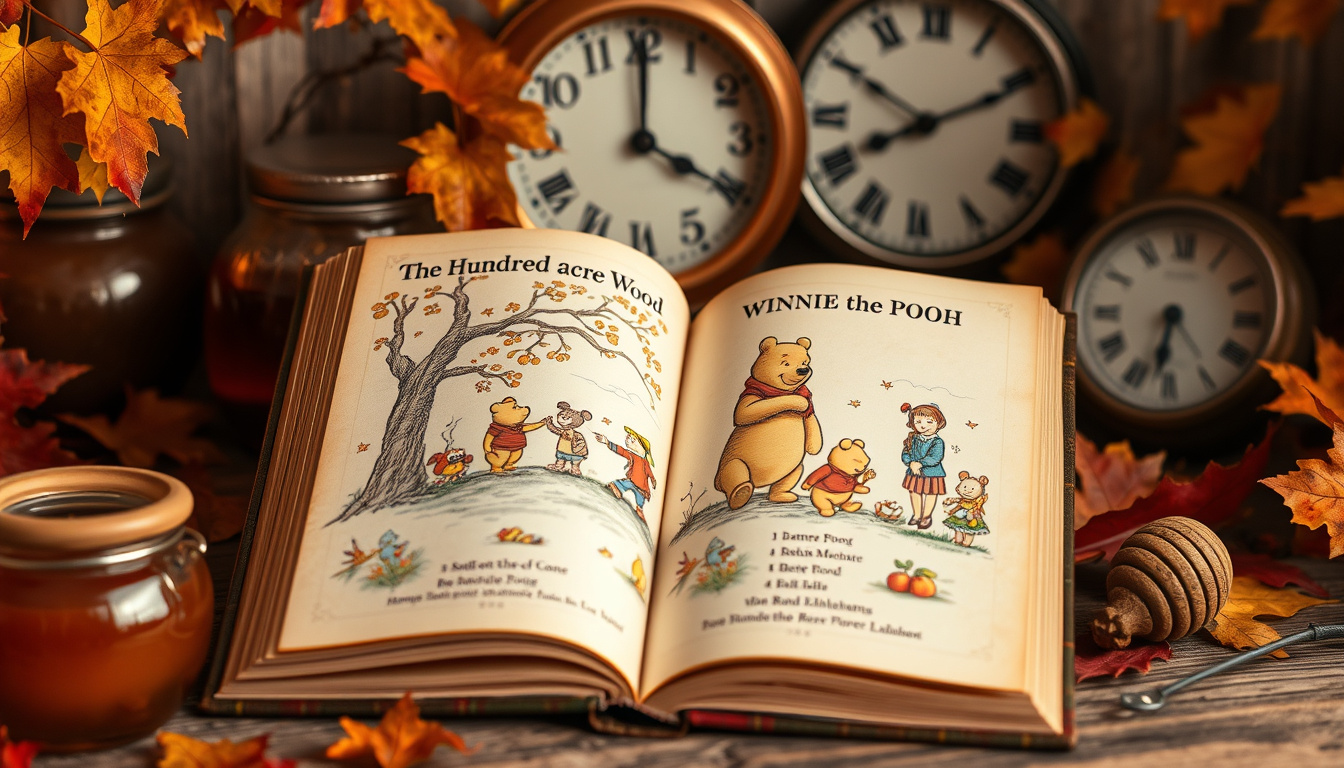
Few fictional bears have captured hearts and sparked debates quite like Winnie the Pooh, from A. A. Milne’s 1926 classic to modern horror adaptations and fan theories about mental disorders. This guide separates facts from fiction, exploring the real origins of the Hundred Acre Wood characters and the popular but unofficial psychological interpretations.
First published: 1926 · Number of original books: 2 · Creator: A. A. Milne · Illustrator: E. H. Shepard
Quick snapshot
- Winnie-the-Pooh first appeared in 1926 (Encyclopaedia Britannica)
- The 2000 CMAJ article is the academic source for the mental disorder theory (PubMed Central)
- A. A. Milne wrote two Winnie-the-Pooh books (Encyclopaedia Britannica)
- Whether the characters were intentionally designed to represent mental disorders (Rethink Mental Illness)
- The exact nature of Pooh’s mental health representation is debated (PubMed Central)
- Christopher Robin’s speculated schizophrenia is disputed (Earkick)
- 1926: First Winnie-the-Pooh book published (Encyclopaedia Britannica)
- 2000: CMAJ article “Pathology in the Hundred Acre Wood” published (PubMed Central)
- 2026: 100th anniversary of the first book (Encyclopaedia Britannica)
- The fan theory continues to evolve online (CareScribe)
- Horror adaptations like “Winnie-the-Pooh: Blood and Honey” extend the cultural conversation (CareScribe)
A quick look at the character’s basic facts:
| Label | Value |
|---|---|
| Full name | Winnie the Pooh |
| First appearance | 1926 (Encyclopaedia Britannica) |
| Creator | A. A. Milne (Encyclopaedia Britannica) |
| Number of books | 2 (Encyclopaedia Britannica) |
Who are Pooh’s friends?
Winnie the Pooh shares the Hundred Acre Wood with a cast of well-known characters: Piglet, Eeyore, Tigger, Rabbit, Owl, Kanga, Roo, and his human friend Christopher Robin (Rethink Mental Illness). Each friend has a distinct personality that has been analyzed in psychological contexts.
What is the Hundred Acre Wood?
The Hundred Acre Wood is the fictional forest setting where Winnie the Pooh and his friends live (Encyclopaedia Britannica). Based loosely on Ashdown Forest in East Sussex, England, it serves as the backdrop for Milne’s stories.
The implication: The friendships themselves are straightforward, but the psychological readings attached to them are entirely modern inventions.
Is Winnie the Pooh 100 years old?
Winnie-the-Pooh first appeared in print on October 14, 1926, when the book Winnie-the-Pooh was published by Methuen in the UK (Encyclopaedia Britannica). That means the character will celebrate its 100th anniversary in 2026.
When is Winnie-the-Pooh Day?
Winnie-the-Pooh Day is observed annually on August 21, the birthday of A. A. Milne’s son, Christopher Robin Milne, who inspired the human character. The 100th anniversary of the book falls in 2026, making that year special for fans.
The 100th anniversary is a chance to revisit the original stories without the filter of modern interpretations — and to appreciate Milne’s work as it was intended.
The approaching milestone invites readers to set aside contemporary theories and rediscover the charm of the original tales.
Why was Eeyore killed?
Eeyore’s death is a plot point in the horror film Winnie-the-Pooh: Blood and Honey and its sequels, part of the “Twisted Childhood Universe.” This adaptation is not part of the original Milne stories and is a fictional reinterpretation (Rethink Mental Illness).
What is the Twisted Childhood Universe?
The Twisted Childhood Universe (TCU) is a series of horror films that reimagine classic childhood characters in violent scenarios. It began with Winnie-the-Pooh: Blood and Honey and includes other Milne characters. The films are not associated with Disney or the original books.
The pattern: Horror spin-offs generate attention but do not alter the literary canon; the original Eeyore remains unchanged.
Do Winnie the Pooh characters really represent different mental disorders?
The idea that each character represents a mental disorder gained traction after a 2000 article in the Canadian Medical Association Journal titled “Pathology in the Hundred Acre Wood: a neurodevelopmental perspective on A.A. Milne” (PubMed Central). The paper humorously suggested that each character exhibits symptoms of specific disorders, but it stressed that this was a neurodevelopmental perspective, not a clinical diagnosis.
What is Pooh’s mental illness?
In the CMAJ article, Pooh’s behaviors are discussed as raising possibilities including obsessive-compulsive disorder (OCD), attention-deficit/hyperactivity disorder (ADHD), and overweight/obesity-related concerns (PubMed Central). Online summaries often add that Pooh may fit ADHD-inattentive presentation because of distractibility, forgetfulness, and impulsivity (CareScribe).
Which Pooh character is ADHD?
Tigger is commonly mapped to ADHD-like traits because of high energy, impulsivity, and risk-taking (ABM Health Services). Pooh is also sometimes linked to ADHD due to his distractibility (PubMed Central).
What is Winnie the Pooh’s disability theory?
The disability theory is a broader fan interpretation that extends beyond mental illness to neurodivergence, comorbidity, and developmental conditions. It has evolved from a simple one-to-one mapping of psychiatric labels into a more nuanced discussion of neurodiversity (CareScribe).
The implication: These interpretations are not officially endorsed by A. A. Milne or Disney and should be treated as speculative cultural commentary, not medical fact.
Is Piglet a boy or girl LGBT?
Piglet is canonically male in the original books and Disney adaptations (Rethink Mental Illness). Some fans have interpreted Piglet as LGBTQ+ due to his gentle nature, but there is no official confirmation from the creators or Disney.
The catch: Fan readings can be meaningful in their own right, but they should not be mistaken for creator intent.
Timeline signal
- 1926: First Winnie-the-Pooh book published (Encyclopaedia Britannica)
- 2000: CMAJ article “Pathology in the Hundred Acre Wood” published (PubMed Central)
- 2026: 100th anniversary of the first book
The chronology shows how a beloved children’s book eventually spawned a diagnostic meme, then entered a horror phase — all within a century.
What we know vs. what’s speculation
Confirmed facts
- Winnie-the-Pooh first appeared in 1926 (Encyclopaedia Britannica)
- A. A. Milne wrote two Winnie-the-Pooh books (Encyclopaedia Britannica)
- The 2000 CMAJ article is the academic source behind the mental disorder theory (PubMed Central)
What’s speculation
- Whether the characters were intentionally designed to represent mental disorders (Rethink Mental Illness)
- Christopher Robin’s speculated schizophrenia is highly disputed (Earkick)
- Eeyore’s death in the horror adaptation is fictional and not part of the original canon (Rethink Mental Illness)
The distinction matters: readers can enjoy the stories and the theories without conflating the two.
“You are braver than you believe, stronger than you seem, and smarter than you think.”
A. A. Milne
“We suggest that each character in A.A. Milne’s Winnie-the-Pooh stories exhibits symptoms of a specific neurodevelopmental disorder.”
CMAJ article, “Pathology in the Hundred Acre Wood” (PubMed Central)
“There is no official, canonical diagnosis list from A.A. Milne or Disney linking Winnie-the-Pooh characters to mental disorders.”
Rethink Mental Illness (Rethink Mental Illness)
For fans of the Hundred Acre Wood, the enduring power of these characters lies not in diagnostic labels but in the simple joy of their stories. For parents reading to children, the best approach is to enjoy the stories as they were written — without over-pathologizing a bear who just wants honey.
Frequently asked questions
What is the correct order of Winnie the Pooh books?
The first book is Winnie-the-Pooh (1926), followed by The House at Pooh Corner (1928). Both were written by A. A. Milne.
Is Winnie the Pooh a boy or a girl?
Winnie the Pooh is a male bear. He is referred to as “he” in the original books and all official adaptations.
What does Eeyore represent?
Eeyore is often associated with depressive symptoms because of his low mood, pessimism, and hopelessness. This is a fan interpretation, not an official characterization.
Why is Pooh called Pooh?
In the original stories, Pooh is named after a real bear named Winnie (from Canada) and a swan named Pooh. A. A. Milne combined them for the character.
Are the Winnie the Pooh characters based on real people?
The characters are fictional, but Christopher Robin is based on Milne’s son, and the Hundred Acre Wood is based on Ashdown Forest.
How many Winnie the Pooh movies are there?
Disney has produced numerous animated films and series, starting with the 1966 short Winnie the Pooh and the Honey Tree. The live-action horror films are separate.
What is the meaning of the name ‘Winnie-the-Pooh’?
The name comes from a real bear called Winnie (after Winnipeg) and a swan named Pooh. A. A. Milne created the character for his son Christopher Robin.

Ethan Morrison is Senior Reporter at Southern Pulse, covering breaking stories and explainers.