
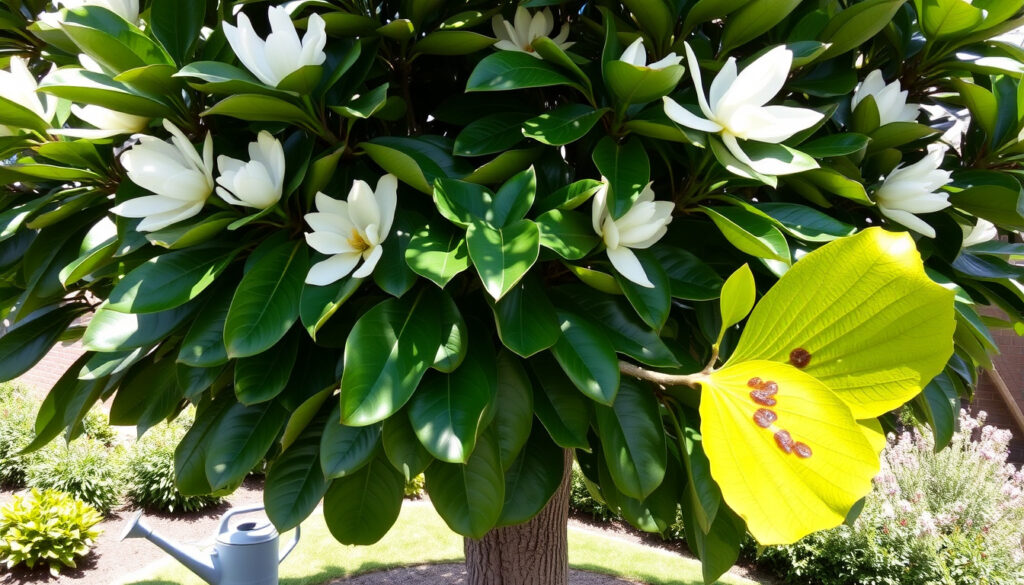
If you’re looking for a compact evergreen that brings Southern charm to a tight urban yard, the Teddy Bear magnolia (Magnolia grandiflora ‘Teddy Bear’) might be exactly the tree you need. It tops out around 15–20 feet tall with a tidy, upright shape that won’t overwhelm a small garden. You’ll find details on its mature size, care routine, common problems, and how it stacks up against the popular Little Gem cultivar – all backed by nursery and extension data.
Mature height: 15–20 ft ·
Mature spread: 8–12 ft ·
Growth rate: 1–2 ft per year ·
Bloom time: Late spring to summer ·
USDA zones: 7–9 ·
Sun requirement: Full sun to partial shade
Quick snapshot
- Mature height 15–20 ft, spread 8–12 ft (Leafy Heaven nursery care guide)
- Compact, upright form with fragrant white blooms (Evergreen Trees specialist grower)
- Thrives in USDA zones 7–9, full sun to partial shade (Platypus Plants horticultural retailer)
- Exact cold hardiness in zone 7b microclimates may vary
- Long-term drought tolerance in clay soils not well documented
- Precise root spread at maturity is extrapolated from similar magnolias
- Reported mature height varies slightly between different nursery sources
- Growth is steady at 1–2 ft per year; no significant timeline events (Evergreen Trees specialist grower)
- Established trees become drought-tolerant; minimal pruning needed
- Watch for leaf spot in humid summers; treat early
Eight key specs, one pattern: the Teddy Bear magnolia is built for tight spaces.
| Specification | Value |
|---|---|
| Botanical name | Magnolia grandiflora ‘Teddy Bear’ (Leafy Heaven nursery care guide) |
| Mature height | 15–20 ft (4.5–6 m) (Evergreen Trees specialist grower) |
| Mature width | 8–12 ft (2.4–3.6 m) (Platypus Plants horticultural retailer) |
| Growth rate | 1–2 ft/year (30–60 cm) (Evergreen Trees specialist grower) |
| Bloom color | White, lemon-scented (Leafy Heaven nursery care guide) |
| USDA hardiness | Zones 7–9 (Platypus Plants horticultural retailer) |
| Sun exposure | Full sun to partial shade (Leafy Heaven nursery care guide) |
| Soil pH | Acidic (5.5–6.5) (Evergreen Trees specialist grower) |
How big does a teddy bear magnolia get?
- Mature height: 15–20 ft (4.5–6 m) (Leafy Heaven nursery care guide)
- Mature spread: 8–12 ft (2.4–3.6 m) (Platypus Plants horticultural retailer)
- Growth rate: 1–2 ft per year (Evergreen Trees specialist grower)
What is the growth rate?
Teddy Bear magnolia grows at a steady 1–2 feet per year under good conditions. That’s moderate – about half the speed of a live oak but faster than a Japanese maple. In comparison, Little Gem can push 30–75 cm per year, making Teddy Bear the slower, denser option (Evergreen Trees specialist grower).
What is the mature spread?
The spread ranges from 8 to 12 feet, which is remarkably narrow for a magnolia. A standard Southern magnolia can span 30 feet or more. Teddy Bear’s compact footprint means it can sit 6–8 feet from a house without crowding the foundation (Platypus Plants horticultural retailer).
You trade vertical screening speed for a tree that won’t bully a small lot. For urban gardeners, that’s a fair swap.
The implication: a 15–20 ft tree with an 8–12 ft spread lets you plant closer to structures than almost any other magnolia without foundation worries later.
What are common problems with teddy bear magnolias?
- Yellowing leaves – often a pH or drainage issue (Leafy Heaven nursery care guide)
- Leaf spot in humid climates (Evergreen Trees specialist grower)
- Scale insects on stems and leaves (Facebook Gardening Group community forum)
- Root stress in compacted or poorly drained soil (Leafy Heaven nursery care guide)
How to treat struggling magnolia teddy bear?
- Check soil drainage – Dig a 12-inch hole and fill with water. If it hasn’t drained in 6 hours, the site needs improvement – raised beds or soil amendment. Compacted soil starves roots of oxygen and triggers leaf yellowing (Leafy Heaven nursery care guide).
- Test soil pH – Teddy Bear prefers acidic soil (pH 5.5–6.5). Alkaline soils cause iron chlorosis – pale leaves with green veins. Apply a sulfur-based acidifier or iron chelate if needed (Evergreen Trees specialist grower).
- Inspect for pests – Scale insects look like small brown bumps on stems. Treat with horticultural oil in early spring. Aphids can be knocked off with a strong spray of water (Facebook Gardening Group community forum).
- Prune damaged branches – Remove any dead or diseased wood after flowering. Teddy Bear needs minimal pruning due to its natural compact shape, but cleaning up frost-damaged tips in zone 7 can prevent decay (Leafy Heaven nursery care guide).
Most problems trace back to planting mistakes – too much shade, poor drainage, or alkaline soil. Fix the site, and the tree largely handles itself.
Bottom line: Teddy Bear magnolia is more disease-resistant than Little Gem, but leaf spot and scale can still appear in wet, humid years. New owners: focus on drainage and pH first.
What is the difference between Little Gem and teddy bear Magnolia trees?
Three differences that matter most: density, speed, and flower shape.
| Feature | Teddy Bear | Little Gem |
|---|---|---|
| Mature height | 10–13 ft (3–4 m) (Leafy Heaven nursery care guide) | 13–20 ft (4–6 m) (Leafy Heaven nursery care guide) |
| Form | Compact, rounded (Platypus Plants horticultural retailer) | Columnar, narrow (Platypus Plants horticultural retailer) |
| Growth rate | 15–50 cm/year (Evergreen Trees specialist grower) | 30–75 cm/year (Evergreen Trees specialist grower) |
| Leaf color | Matte green, larger (Evergreen Trees specialist grower) | Glossy dark green, smaller (Evergreen Trees specialist grower) |
| Flower | Cup-shaped, up to 20 cm, creamy white (Evergreen Trees specialist grower) | Star-shaped, 10–15 cm, white with pink touch (Evergreen Trees specialist grower) |
| Disease resistance | Higher (Evergreen Trees specialist grower) | Moderate (Evergreen Trees specialist grower) |
| Best use | Feature tree, container, small yard (Platypus Plants horticultural retailer) | Screen, hedge, taller backdrop (Platypus Plants horticultural retailer) |
The implication: if you need a dense, low-maintenance specimen for a tight spot, Teddy Bear wins. If vertical screening speed is your goal, Little Gem will get there faster.
Where is the best place to plant a teddy bear magnolia tree?
- Full sun to partial shade – at least 4–6 hours of direct sun (Leafy Heaven nursery care guide)
- Well-drained, acidic soil (pH 5.5–6.5) (Evergreen Trees specialist grower)
- Space 6–8 ft from buildings to allow mature spread (Platypus Plants horticultural retailer)
- Avoid low spots where water pools after rain (Leafy Heaven nursery care guide)
Soil requirements
Acidic, loamy soil is ideal. If your soil is clay or alkaline, amend with peat moss or pine bark. For container growing, use a potting mix formulated for acid-loving plants. Good drainage is non-negotiable – standing water leads to root rot (Evergreen Trees specialist grower).
Sun exposure
Teddy Bear flowers best in full sun. In partial shade, expect fewer blooms and a looser habit. If you live in a hot inland area (zones 9–10), afternoon shade can prevent leaf scorch (Leafy Heaven nursery care guide).
What this means: planting mistakes account for most struggles. Get the sun and drainage right from day one, and your Teddy Bear will settle in quickly. For more on general tree care, our guide on Olive Tree Care Ireland offers similar principles for Mediterranean evergreens.
What are the cons of having a magnolia tree?
Upsides
- Compact size fits small urban lots
- Evergreen foliage provides year-round privacy
- Fragrant blooms late spring through summer
- Low pruning needs due to natural shape
- Drought-tolerant once established
Downsides
- Slow to establish – patience required (Evergreen Trees specialist grower)
- Messy leaf drop in spring (old leaves shed) (Leafy Heaven nursery care guide)
- Surface roots may appear in heavy clay (Leafy Heaven nursery care guide)
- Frost damage possible in zone 7 cold snaps (Platypus Plants horticultural retailer)
- Nutrient deficiencies in alkaline soil (Evergreen Trees specialist grower)
Clarity check: what we know and what’s fuzzy
Confirmed facts
- Mature size is consistently reported at 15–20 ft tall, 8–12 ft wide across multiple nursery sources (Leafy Heaven nursery care guide, Platypus Plants horticultural retailer).
- Compact growth habit is a genetic trait of the cultivar, not environmental.
- Fragrant white blooms appear late spring through summer (Evergreen Trees specialist grower).
- More disease-resistant than Little Gem (Evergreen Trees specialist grower).
What’s still uncertain
- Exact cold hardiness in zone 7b microclimates may vary.
- Long-term drought tolerance in clay soils not well documented.
- Precise root spread at maturity is extrapolated from similar magnolias.
- Reported mature height varies slightly between different nursery sources.
Expert perspectives
Cute, compact and classic: It’s Teddy Bear magnolia – a southern magnolia that fits modern landscapes.
— LSU AgCenter (Louisiana State University agricultural extension)
This very compact southern magnolia features an upright form with shiny, deep green leaves that have heavy, brown felt underneath.
— Monrovia (premium nursery grower)
The same compact density that makes Teddy Bear perfect for small gardens also means it’s slower to fill a screen. You get a manageable specimen tree – but you don’t get a fast hedge.
The pattern across expert sources: Teddy Bear is praised for its form and disease resistance, while Little Gem is valued for speed and screening. For a homeowner with a 20 x 20 ft front yard, Teddy Bear is the smarter fit. For someone creating a privacy border along a fence, Little Gem wins.
For a deeper look at how this compact evergreen performs in suburban gardens, see the Teddy Bear Magnolia care guide from Oz Focus Hub.
Frequently asked questions
Is Teddy Bear magnolia evergreen?
Yes, it retains its leathery green leaves year-round, though it drops older leaves in spring as new growth emerges (Leafy Heaven nursery care guide).
How much sun does Teddy Bear magnolia need?
Full sun to partial shade – at least 4–6 hours of direct sun for best flowering (Leafy Heaven nursery care guide).
When to fertilize Teddy Bear magnolia?
Apply a slow-release acid-loving fertilizer in early spring, just before new growth starts (Evergreen Trees specialist grower).
Does Teddy Bear magnolia attract pollinators?
Yes – its large, fragrant flowers attract bees and other native pollinators from late spring through summer (Evergreen Trees specialist grower).
Can Teddy Bear magnolia grow in containers?
Yes, it’s one of the best magnolias for pots. Use a large container (at least 24 in diameter) with drainage holes and acidic potting mix (Platypus Plants horticultural retailer).
How to prune Teddy Bear magnolia?
Prune lightly after flowering – remove crossing branches and dead wood. No heavy pruning needed due to its naturally compact shape (Leafy Heaven nursery care guide).
What is the best time to plant Teddy Bear magnolia?
Plant in early spring or fall when temperatures are mild. Avoid planting during hot summer months to reduce transplant stress (Platypus Plants horticultural retailer).
For more tree care basics, our Myer Christmas Tree Buying Guide covers selection and care for another popular tree genus.
For the homeowner measuring a 30 x 40 ft plot, the choice is clear: pick Teddy Bear if you want a compact specimen that won’t overpower the yard. Pick Little Gem if you need a taller screen and can wait a few more years. The trade-off between density and speed defines this decision – and only your space constraints can tip the scale.

Grace Clarke leads fact-checking, source verification and corrections at Southern Pulse.