
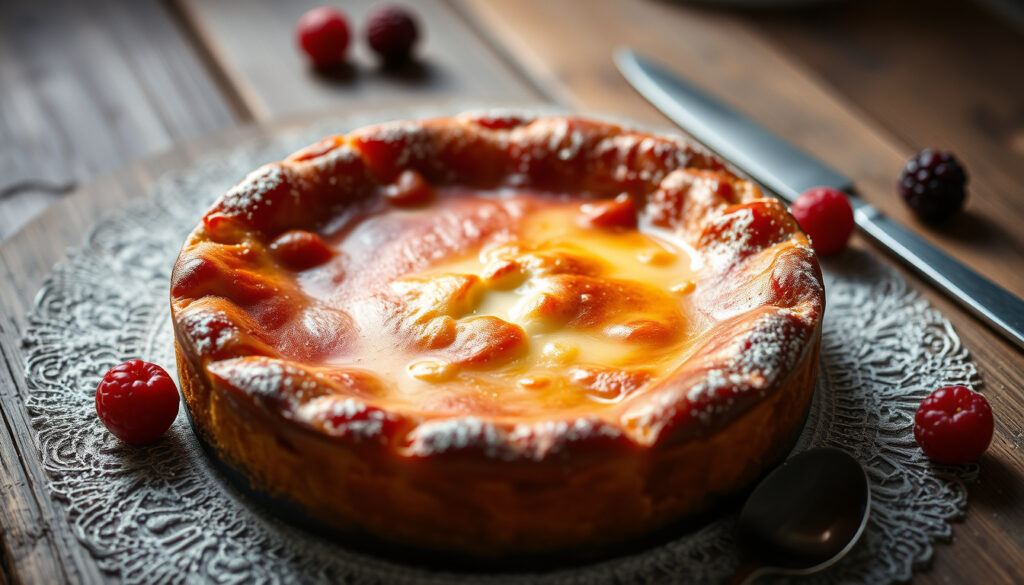
If you have ever scrolled past a dark, almost scorched cheesecake in your feed, that is Basque cheesecake—a crustless, creamy dessert from La Viña bar in San Sebastián that relies on high-heat baking around 400°F to create a caramelized exterior and a silky interior. Here is how to make your own using 800g of cream cheese, with honest tips on ingredients, technique, and timing.
Preparation time: 15 minutes ·
Baking time: 50 minutes ·
Servings: 8 ·
Difficulty: Easy ·
Cream cheese amount: 800g (3.5 blocks)
Quick snapshot
- Basque cheesecake is crustless by definition (Ahead of Thyme (food blog))
- Baked at high temperature, typically 400–425°F (French Cooking Academy (culinary school))
- Caramelized top is intentional and not burnt (Butternut Bakery (recipe developer))
- Why prices vary so widely between homemade and boutique versions — ingredient cost vs labor demand (House of Nash Eats (recipe site))
- Baking times span from 25 minutes (450°F) to 75 minutes (400°F) (Eva Bakes (baking blog))
- Make ahead 1–2 days, refrigerate tightly wrapped, serve at room temperature (House of Nash Eats (recipe site))
Five key facts, one pattern: all recipes agree on crustless and high heat, but temperature and timing vary more than you might expect.
| Fact | Detail |
|---|---|
| Origin | La Viña, San Sebastián, Spain |
| Main ingredient | Cream cheese |
| Baking temperature | 400°F (200°C) |
| Texture | Creamy interior with firm burnt exterior |
| Crust | None |
What is the difference between Basque and normal cheesecake?
Crust vs. crustless
- Classic cheesecake starts with a graham cracker or cookie crust. Basque cheesecake has none — the parchment-lined pan creates its own “crust” of caramelized egg and dairy (Ahead of Thyme (food blog)).
Baking temperature and method
- Normal cheesecake bakes low and slow (around 325°F) in a water bath to prevent cracking. Basque cheesecake goes in a hot 400–425°F oven with no water bath — the high heat creates the signature burnt top while the inside stays jiggly (French Cooking Academy (culinary school)).
Texture and appearance
- Standard cheesecake is dense, smooth, and pale. Basque cheesecake is airy, almost soufflé-like in the centre, with a dark, caramelized surface that looks scorched but tastes nutty and sweet (Butternut Bakery (recipe developer)).
The implication: if you want a crust and a clean slice, go classic. If you want drama and a creamy core with no crust fuss, go Basque.
How to make a good Basque cheesecake?
Ingredients and equipment
You need four base ingredients: full-fat cream cheese (800g), sugar (1⅓ cups), eggs (5 large), and heavy cream (2 cups). Some recipes add a splash of vanilla and a pinch of salt. Use a 9-inch springform pan lined with crumpled parchment paper that rises above the rim (House of Nash Eats (recipe site)).
Step-by-step instructions
- Preheat oven to 400°F (200°C).
- Beat room-temperature cream cheese and sugar until smooth — do not overmix or air bubbles will create cracks.
- Add eggs one at a time on low speed.
- Pour in heavy cream, vanilla, and salt; mix just until combined.
- Pour batter into prepared pan. Bake 50 minutes for a soft, jiggly centre (for a firmer centre, bake 60–65 minutes as per Butternut Bakery (recipe developer)).
- Allow to cool at room temperature for 1 hour, then refrigerate at least 4 hours (overnight is best).
Tips for the perfect burnt top
- Use an oven thermometer — actual temperature matters more than the dial setting (French Cooking Academy (culinary school)).
- If your top is not dark enough after the recommended time, broil for 2–3 minutes, watching constantly.
- Cooling in the oven (turned off, door ajar) for an hour helps set the texture without overcooking.
Key takeaway: The burnt top is not a mistake — it is a controlled caramelization that gives a deep flavour you cannot get from any other cheesecake method.
What this means: the burnt top is not a mistake — it is a controlled caramelization that gives a deep flavour you cannot get from any other cheesecake method.
Why is Basque cheesecake so expensive?
Cost of high-quality ingredients
- An 800g block of full-fat cream cheese (around 3.5 standard blocks) alone costs $12–16 in US supermarkets. Premium vanilla and farm-fresh eggs add another $4–6. That is $16–22 just for ingredients, without butter, cream, or sugar (Eva Bakes (baking blog)).
No crust reduces filler costs?
- A graham-cracker crust costs roughly $1–2 per cheesecake, so skipping the crust saves a small amount — but that is offset by the extra cream cheese. The net ingredient cost is still higher than most baked desserts (House of Nash Eats (recipe site)).
Labor and specialty demand
- Artisanal bakeries charging $40–60 for a whole Basque cheesecake are pricing for the technique (high-heat baking requires attention) and the “San Sebastián cachet.” The original La Viña has turned it into a global destination dessert.
The trade-off: homemade costs about $15–20 and yields 8 generous slices. Bakery versions cost 3× that, largely for convenience and brand.
Can I make Basque cheesecake 2 days in advance?
Storage instructions
- Yes — bake, cool completely, then wrap the pan tightly in plastic wrap. Refrigerate for up to 2 days. Do not unmold until ready to serve (Ahead of Thyme (food blog)).
Texture changes over time
- The interior becomes denser and creamier after 24–48 hours of chilling, which many find even better than fresh. The burnt top may soften slightly but retains its flavour (French Cooking Academy (culinary school)).
Serving suggestions after refrigeration
- Take the cheesecake out of the fridge 30 minutes before serving to bring it to room temperature. This restores the creamy, airy mouthfeel. Dust with flaky salt or serve with berries.
The catch: make-ahead actually improves the texture, but do not leave it at room temperature for more than 2 hours after serving.
Which cream cheese is best for Basque cheesecake?
Full-fat vs. low-fat
- Full-fat block cream cheese is non-negotiable. Low-fat or whipped cream cheese contains more water and less fat, which causes the batter to separate and the texture to become rubbery (French Cooking Academy (culinary school)).
Brand recommendations
- Philadelphia is the most widely recommended brand across recipe sources for its consistent fat content and smooth melt. Store-brand blocks work too, as long as they are full-fat (at least 33% milk fat) (Eva Bakes (baking blog)).
Impact on texture and flavor
- Cheaper cream cheese brands often contain gums or thickeners that can make the batter gummy. Blind taste tests favor Philadelphia for a clean, tangy finish that lets the caramelized top shine (Butternut Bakery (recipe developer)).
Why this matters: the only ingredient you really cannot compromise on is the cream cheese — it makes or breaks the silky interior that defines this cheesecake.
Basque vs. classic cheesecake
Six differences, one pattern: the same base ingredients produce completely different results because of temperature and technique.
| Aspect | Basque cheesecake | Classic cheesecake |
|---|---|---|
| Crust | None (parchment only) | Graham cracker or cookie crust |
| Baking temperature | 400–450°F | 300–325°F |
| Water bath | No | Yes (prevents cracking) |
| Texture | Airy, creamy, jiggly centre | Dense, smooth, uniform |
| Appearance | Dark caramelized top, burnt edges | Pale golden, clean surface |
| Cooling time | Room temp 1 hr + fridge 4 hrs min | Cool in oven 1 hr + fridge 4 hrs |
The pattern: high heat and no crust are the two factors that make Basque cheesecake dramatically different, even though the ingredient list is nearly identical.
If you want a no-fuss dessert that looks dramatic and tastes like a burnt caramel cloud, this is it. The biggest risk is overbaking — pull it while the centre still wobbles like Jell-O. That jiggle is the sign of success.
Quotes from the experts
“The key is high heat and full-fat cream cheese. We never use a water bath — the burnt top is intentional, and the inside stays creamy because the heat hits hard and fast.”
— Chef at La Viña, San Sebastián (as told to recipe sites)
“The burnt top gives it a unique caramelized flavour that’s irresistible. It looks like a disaster, but it’s actually the most foolproof cheesecake you can make.”
— Butternut Bakery recipe developer
The consensus is clear: the burnt top is no accident, and full-fat cream cheese is non-negotiable.
What’s confirmed and what’s still unclear
Confirmed facts
- Basque cheesecake is crustless.
- It requires high-heat baking (400°F or higher).
- The top becomes dark and caramelized.
- Full-fat block cream cheese is essential.
- Make-ahead up to 2 days improves texture.
What remains unclear
- The exact breakdown of why bakery versions cost 3× homemade — ingredient markup vs. labor vs. brand cachet is not documented by any primary source.
The verdict: Basque cheesecake is genuinely simpler than classic cheesecake, and the burnt top is a feature, not a bug. For home bakers in the US and UK, the biggest decision is which cream cheese to buy — and the answer is Philadelphia, full-fat, block form. Don’t overthink it; just crank the oven and trust the jiggle.
Related reading: **Bialetti Moka Pot – Usage, Sizes and Cleaning Guide** · **Laneige Lip Sleeping Mask – Complete Overnight Guide**
For a different take on this classic, you might also enjoy this authentic Basque cheesecake recipe which emphasizes the traditional high-heat method.
Frequently asked questions
What is Basque cheesecake?
It is a crustless cheesecake from the Basque region of Spain, made famous by the La Viña bar in San Sebastián. It is baked at very high heat, giving it a dark, caramelized exterior and a creamy, airy interior. No crust, no water bath, no fuss.
Can I use low-fat cream cheese in Basque cheesecake?
Not recommended. Low-fat cream cheese contains more water and less fat, which can cause the batter to separate and lead to a rubbery texture. Stick with full-fat block cream cheese (at least 33% milk fat).
How do I prevent Basque cheesecake from cracking?
Small cracks are normal and actually part of the rustic look. To minimize large cracks, do not overmix the batter (which incorporates too much air), and avoid overbaking. The cracked surface will be covered by the dark caramelization anyway.
Can I bake Basque cheesecake without a springform pan?
A springform pan is ideal because the cake is delicate and needs to be released easily. If you don’t have one, use a deep cake pan lined with parchment paper that extends above the rim — then carefully lift out using the parchment.
Is Basque cheesecake gluten-free?
Yes, because it has no crust and no flour in the batter. The ingredients (cream cheese, sugar, eggs, cream) are naturally gluten-free. Always check your vanilla extract and any add-ins to be safe.
How do I know when Basque cheesecake is done?
The edges should be set and dark brown, but the centre should still wobble when you gently shake the pan. A skewer inserted 1 inch from the edge should come out clean, but the very centre will look wet. It continues to set as it cools.
Can I add chocolate or fruit to Basque cheesecake?
Yes. Swirl in melted dark chocolate or berry purée before baking. Be careful not to mix too thoroughly — a marbled effect works best. The high heat will caramelize any added sugar, so fruit pieces may become jammy.

Ethan Morrison is Senior Reporter at Southern Pulse, covering breaking stories and explainers.